The Digital Apparel Revolution: What’s Driving Fashion’s Next Big Shift

Learn moreright arrow

AI-Powered Apparel ERP Software: Real Use-Case, Strategy Benefits & Trends for Apparel Manufacturers

12 mins read • 7th, Apr 2026

Introduction

For over a decade, the fashion industry has been shifting to AI-powered ERP solutions. Digging through traditional ERP dashboards alone can not drive success.

Here is reality: the ongoing surge for faster builds, lower costs, and greener methods – hitting these targets without losing quality or profit is the new norm. Now, manufacturers must balance speed with care, cutting waste but keeping standards high. Meeting demand means streamlining processes while protecting the bottom line. Efficiency matters, though corners cannot be skipped. Progress drives production; excellence remains central.

In this ever-changing market, traditional ERP systems are fast becoming a burden, hindering manufacturing growth because they fail to respond quickly to changing market conditions. They are reactive, data-heavy, and not intelligent enough to be an effective solution for apparel businesses today.

As per the apparel market trends:

  • Every year, clothes makers produce way too much – about one-fifth to almost a third more than needed, according to fashion sector numbers
  • Every year, messed-up inventory – too much of some items, none of others – wipes out nearly $1.1 trillion across retail worldwide, says Gartner
  • AI can reduce inventory levels by 20–30% while improving service levels
  • Companies using AI in supply chains see 15% lower logistics costs

To fill this gap, AI-powered Apparel Manufacturing ERP software comes in.

By integrating Artificial Intelligence into ERP systems, manufacturers can leverage an end-to-end integrated cloud dashboard for real insight, interactive visualizations, fast-centralized reporting to cut data silos.

By the end of the Blog, you will learn:

  • Importance of AI-Powered Apparel ERP
  • Real challenges of apparel manufacturing today
  • AI use cases in real-world ERP systems
  • Strategic benefits for manufacturers
  • Future trends shaping the industry
  • Top ERP solutions: How to pick the right one

AI in the Apparel Industry - Future Trends

  • The market for AI in manufacturing globally was projected towards $20+ billion by 2028 (Statista)
  • Productivity growth in the manufacturing industry is expected to escalate by over 40% (Accenture)
  • Predictive supply chains can avoid forecasting errors by 20-50%, with integrated modern AI ERP Dashboards (McKinsey)
  • Companies using AI-driven personalization benefit from 5-15% revenue growth (McKinsey)
  • Generative AI can shorten product development time by 30-50% (BCG)

What is Apparel Manufacturing ERP Software for Industries?

The apparel industry is at an inflexion point where speed, accuracy and flexibility aren’t just competitive advantages, they’re table stakes. The traditional systems we have in place to address the challenges arising from rapidly evolving trends, erratic demand and more complex global supply chains.

The problem is, most traditional ERP systems weren’t built for this pace. They rely on past data and manual inputs, so by the time insights come in, it’s often already too late. This leads to common issues, too much stock in some places, shortages in others, and slow reactions to what the market actually needs.

AI-driven ERP fills this gap by transforming data into live intelligence. This facilitates demand forecasting, production optimization, waste reduction, and speed-to-market, with a decrease in manual work.

For apparel manufacturers, this transition means greater agility, lower costs and quicker time-to-market.

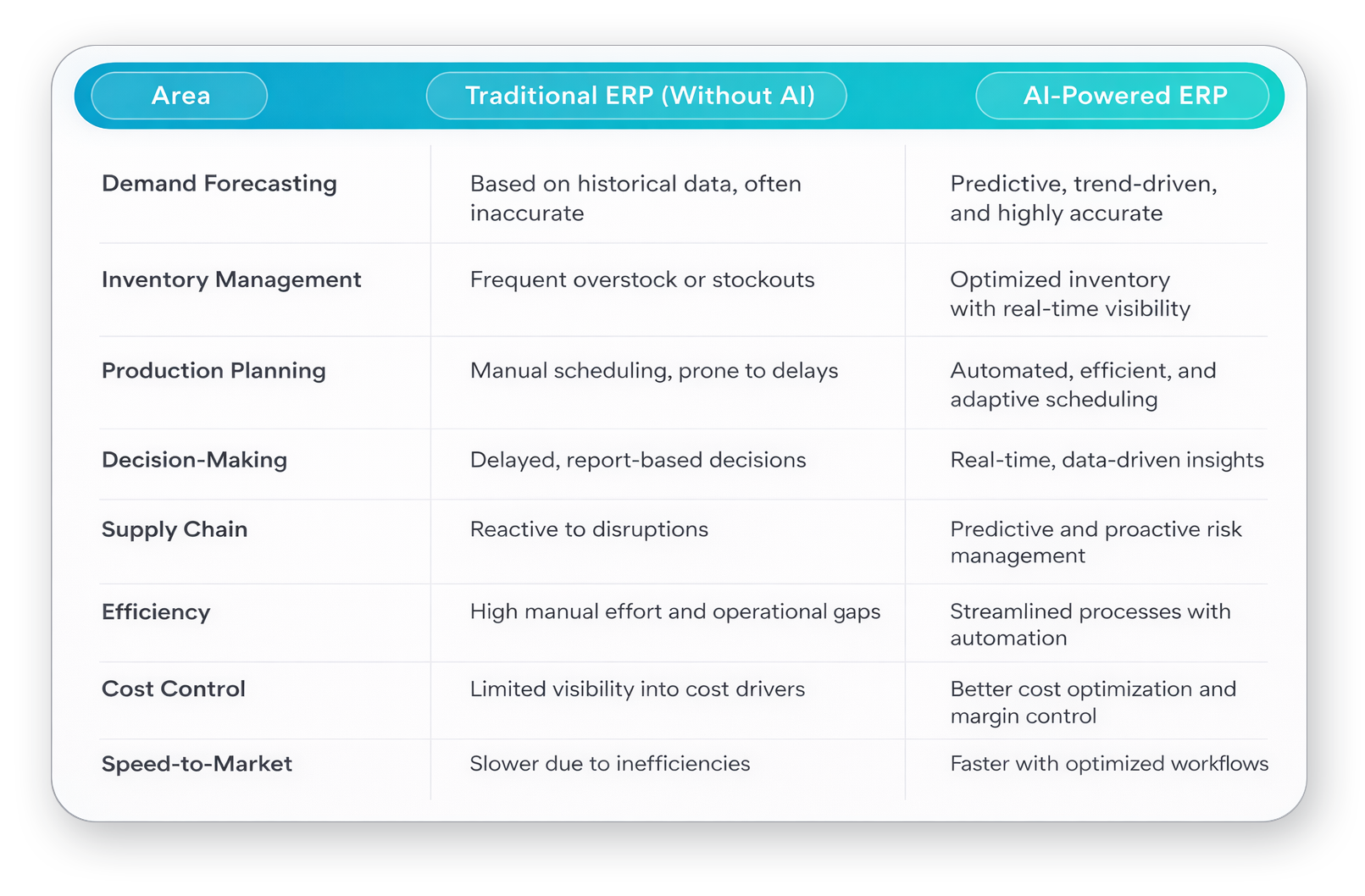
AI-Powered vs Traditional ERP: Impact on Apparel Manufacturing

AI-ERP vs Traditional ERP

How AI Enhances ERP Capabilities?

Did you know,

  • Bad data led businesses to a loss of 12.9 million dollars, as per Gartner. Whereas, adopting Cloud ERP can bring down IT costs by 20–30% (Deloitte)

The integration of artificial intelligence with an apparel ERP transforms the system from a simple data management tool into an intelligent decision-making engine.

Rather than relying on manual inputs and static reporting, AI-driven ERP equips leaders with up-to-the-minute dashboards and predictive analytics powered by machine learning that easily adapt to evolving needs. 

How AI ERP Works: 

  • Constantly checks data from design, production and sales
  • It learns from historical & real time business data
  • AI-enhanced ERP solution automatically predicts anomalies, reflects past data,  predict future strategy trends
  • Eliminate manual interpretations and operational decisions with combined action-based data

For apparel companies grappling with rapidly evolving trends and tangled supply lines, this enables operations to be faster, smarter, and more agile.

Key AI technologies in Apparel ERP

  • Machine Learning (ML)
    This is about up-to-date data. It’s trained on historical orders, seasonality trends and production cycles.
  • Predictive Analytics
    When predictions shift, supply hiccups follow – keeping stock balanced becomes a moving target. Market swings hit harder if timing slips. Staying ahead means adjusting before the rush hits.
  • Computer Vision
    A machine spots flaws in knit patterns and flags uneven stitches. Product differences are detected instantly through continuous scanning. Mistakes are caught without slowing production.
  • Natural Language Processing
    Talking to the system feels like chatting with a person. It simplifies how you report and find information, while keeping messages clear. Each step flows without extra effort.

Core ERP functions enhanced by AI

AI Enhances Important Operational Processes in Apparel Manufacturing:

  • Planning & Forecasting: useful regarding demand and smart production scheduling
  • Inventory Management: Maintaining healthy stock levels and intelligent restocking
  • Production: Monitor in real-time, identify bottlenecks and optimize efficiency
  • Sourcing:  Selecting suppliers based on data and managing their risk

Key Challenges in Apparel Manufacturing

Despite technological advancements, manufacturers still face critical challenges:

1. Demand Volatility

What sticks around one season vanishes fast. Sudden shifts keep buyers guessing.

2. Inventory Imbalance

Too much made means unsold goods pile up. Not enough is made, so customers walk away empty-handed.

3. Complex Supply Chains

Faraway suppliers can lead to surprises, with items arriving late. Juggling teams across time zones adds friction without warning. Distance stretches timelines in ways hard to predict.

4. Production Inefficiencies

When people plan by hand, problems tend to build up over time. One delay usually pulls another along behind it.

5. Quality Issues

Faulty consistency in output leads to fixes afterwards, items sent back, and frustrated buyers.

6. Rising Costs And Shrinking Margins

Workers’ pay keeps climbing higher. Building supplies cost more every month. Delivery expenses rise without slowing down.

Real Use Cases of AI in Apparel ERP for Apparel Manufacturers & Textile Mills

Utilizing real-time data, historical insights, and predictive intelligence means the apparel business can vastly increase efficiency, drive down associated costs and react to an ever-changing world of fashion at speed.

Forecasting Demand & Predicting Trends

AI analyses historical sales data, seasonal trends, and external market signals to forecast demand with high accuracy. It also spots emerging fashion trends sooner, allowing brands to get ahead of them.

How AI Helps:

  • It studies how demand has changed over time and gives a more realistic estimate of what’s coming next, helping avoid overproduction
  • It continues to track market signals and sales patterns, so teams can spot trends early and plan collections with greater confidence.

Impact:

  • More accurate demand forecasting
  • Better production planning
  • Reduced overproduction

Inventory Optimization

Each piece, size, or cut adds layers to the process of keeping track of the clothing supply. Fueled by smart systems, updates on what’s available surface instantly, while restocking decisions happen without delay.

How AI Helps:

  • Powered by multi-echelon optimization algorithms, AI evenly distributes inventory across sites, leading to decreased dead stock levels and increased availability
  • By tracking demand signals and stock movement in real time, AI automates replenishment decisions at every stage of the supply chain for improved inventory turnover and reduced holding costs

Impact:

  • Reduced dead stock
  • Improved inventory turnover
  • Lower holding costs

Production Planning and Scheduling

Fresh insights from the shop floor shape how tasks unfold, streamlining schedules without delay. 

How AI Helps:

  • AI is also widely applied to automate production scheduling using constraint-based planning in combination with real-time shop floor data, significantly improving capacity utilization.
  • Enhancing production cycles: enhanced simulations & analytics AI identifies and resolves bottlenecks with simulation models and performance analytics, resulting in faster production cycles with fewer delays.

Impact:

  • Production scheduling and capacity planning automated
  • Detecting bottlenecks and ongoing process improvements

Quality Control & Failure Identification

AI-enabled computer vision systems can inspect fabric and finished garments with greater accuracy than manual checks, therefore reducing the reliance on human inspection.

How AI Helps:

  • AI use computer vision models(trained on fabric and garments dataset) to detect defects in real time, minimizing rework & maintaining better quality consistency
  • AI harmonizes quality checks by cross-verifying outputs with predetermined metrics, reducing human errors and inconsistencies

Impact:

  • Visual inspection for defect detection funded by AI
  • Decrease in errors, rework and quality variations

Supplier & Vendor Management

AI assists in evaluating supplier performance based on past performance, adherence to deadlines, and quality standards to identify the most reliable suppliers.

How AI Helps:

  • This results in more reliable sourcing as AI assesses the reliability of suppliers utilizing performance scoring models around delivery timelines, quality metrics and compliance data
  • AI uses advanced analytics to predict supply chain risks using both historical and real-time data, keeping vendor management proactive

Impact:

  • Tracking vendor performance and analyzing risk
  • Data-driven sourcing and supplier selection

Costing & Pricing Optimization

AI allows for accurate cost estimation by evaluating material, labor, and operational costs; it can also propose perfect pricing methods.

How AI Helps:

  • AI allows calculation of accurate product costs by analyzing materials, labor time and overheads at every stage of production for better cost control
  • AI analysis of demand patterns and market trends yields better margins and more competitive pricing.

Impact:

  • Detailed cost estimation along with the different steps of production
  • Intelligently priced data-backed margin improvement

Refunds Reduction & Product Precision

Returns present a big problem in fashion. What’s also crucial is that technology enables greater accuracy in evaluating fit, sizing trends, and customer feedback.

How AI Helps:

  • AI is used to anticipate sizing and fit issues based on customer feedback, returns data, and even pattern analysis, improving the overall accuracy of product offerings
  • AI uses data clustering and analysis to provide insights into repeat product issues, helping reduce product returns, waste, and even reverse logistics costs.

Impact:

  • The low-downs: insights for better sizing, fit consistency, and product accuracy
  • Minimize returns, waste and reverse logistics costs

Strategic Benefits of AI-Powered ERP

AI-Powered ERP

Facing endless change, clothing makers now wrestle with unstable supply chains alongside rising costs. Pressure builds when eco demands tighten while rivals push harder. Here, tiny flaws in daily work quickly bleed profit and stall expansion.

Few things matter more than seeing what your operations are doing, while steering them firmly.

One system ties together clothing manufacturing tasks – like making products, tracking inventory, handling money flow, plus managing suppliers – using smart tech. When information flows freely across departments, factories gain a full view of what is happening right now. Seeing everything at once helps teams choose next steps more quickly while adapting more easily to changes.

Businesses use this setup to:

  • Streamline order-to-cash processes
  • Improve Demand Predictions and Production Scheduling
  • Gain real-time supply chain insights
  • Improve stock and storage handling
  • Improved financial oversight and reporting accuracy
  • Support omnichannel delivery for both business and consumer orders

Built right into PLM and production tools, their cloud setup scales smoothly as demand shifts. That flexibility makes adjustments feel natural as priorities evolve.

When it comes down to it, bringing data and workflows together helps clothing makers reduce clutter, work more smoothly, and build a stronger setup built for what’s ahead.

AI-Powered ERP Implementation Considerations

Choosing the right ERP solutions for your textile mills and apparel businesses is crucial, especially if you have a large base. It is a decision to shift from raw interpretations to decision intelligence. That’s why you need to check the right category of ERP Dashboards. Here is how you can choose the right ERP: 

Evaluating Current ERP Readiness
Determine if your existing ERP system could support AI capabilities or needs modernization. Legacy systems often use detailed data formats that lack flexibility and, therefore, need to be upgraded or replaced to improve scalability and performance.

Importance of Clean, Structured Data
Data is the real game-changer. Lack of standardization and governance can lead to unreal predictions and inefficiencies, leading to unrealistic expectations and outcomes.

Integration with Existing Systems
Enhanced ERP systems come with modern integrated PLM, SCM, WMS, and other tools, creating a complete data ecosystem that provides real-time visibility across functions.

Workforce Training and Change Management
The right ERP solutions come with no or minimal technical training. Modern ERPs offer easy accessibility, usability, compatibility, and shareability.

Choosing the Right AI-Powered ERP Solution

The right ERP solution will influence your entire growth cycle. Smart ERP and PLM softwares is designed to improve efficiency, scalability, and long-term growth, enabling future-ready scalability.

Apparel-Specific Capabilities

Make sure the ERP is actualized for fashion workflow, including size matrices, seasonal collections and overall complex sourcing needs.

Cloud-Based Scalability

Cloud ERP offers a facility, a global reach, a lower investment of capital, upfront cost, and the advantage that they can scale along with you as your business expands.

Integrations with PLM and Supply Chain Software
Seek seamless integration with systems like:

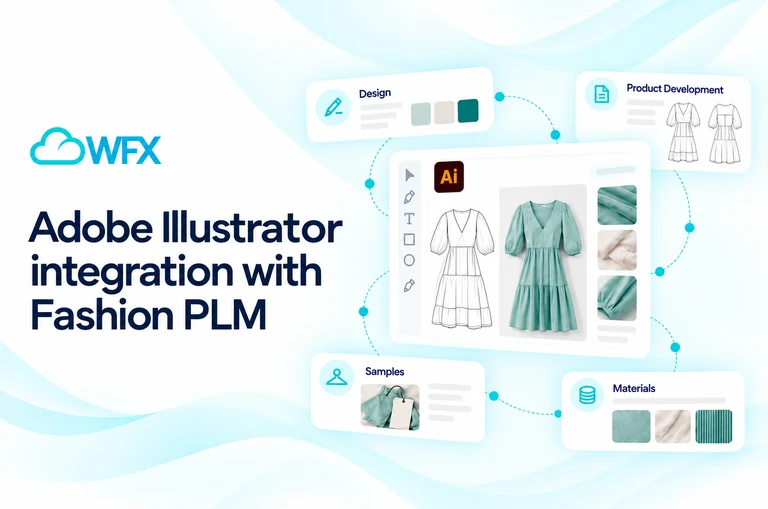
  • PLM tools (e.g., WFX PLM, Centric PLM)
  • SCM platforms
  • Warehouse Management Systems (WMS)
  • EDI and eCommerce platforms

Advanced Analytics and Reporting
Smart, AI-driven dashboards empower brands and businesses to make powerful decisions with real data to identify growth opportunities.

Harness the Power of AI-Powered ERP with WFX

Apparel manufacturers now see big shifts – thanks to smart ERP & PLM solutions. AI-powered ERP solutions help you see through the market trends to win in the competitive race. One moment, they’re adjusting output, the next tracking materials across oceans. Changes arrived fast, not with a plan but through constant small tweaks. What used to take weeks now happens before lunch.

Fashion Brands Using AI ERP Systems See Benefits:

  • Faster decision-making
  • Lower costs
  • Greater efficiency
  • Competitive advantage

Frequently Asked Questions

What is AI-powered apparel ERP software?

Traditional ERP solutions now include the latest technology features to automate processes by predicting what will happen and optimizing them accordingly through AI-powered apparel ERP software.

Do medium or large Apparel Businesses need AI-powered ERP?

Yes, AI-powered cloud-based ERP solutions are highly beneficial  for medium to large scale apparel businesses for better scalability and lower upfront costs.

Best Apparel ERP Software: How to Get the Right One?

Look for:

  • Industry-specific features
  • AI capabilities
  • Integration options
  • Scalability
  • Vendor expertise

Read Our Blogs

...
AI in Fashion PLM: Real Use Cases for Brands and Manufacturers

AI in Fashion PLM boosts efficiency, cuts costs, reduces waste, and speeds product development.

Read More
...
A Complete Guide to Selecting the Right Cloud ERP for Footwear Manufacturing in 2026

Choose the best cloud ERP for footwear manufacturing to boost efficiency and growth

Read More
...
Top 7 Fashion PLM Software Solutions for Apparel Brands in 2026

Discover top Fashion PLM software solutions helping apparel brands streamline product development in 2026.

Read More