A purpose-built apparel ERP doesn’t treat your factory as a generic warehouse. It understands the Item → Color → Size hierarchy that runs through every apparel manufacturing operation — from material planning through production to final shipment.
Here’s what that looks like module by module:
SKU-Level Material Requirement Planning
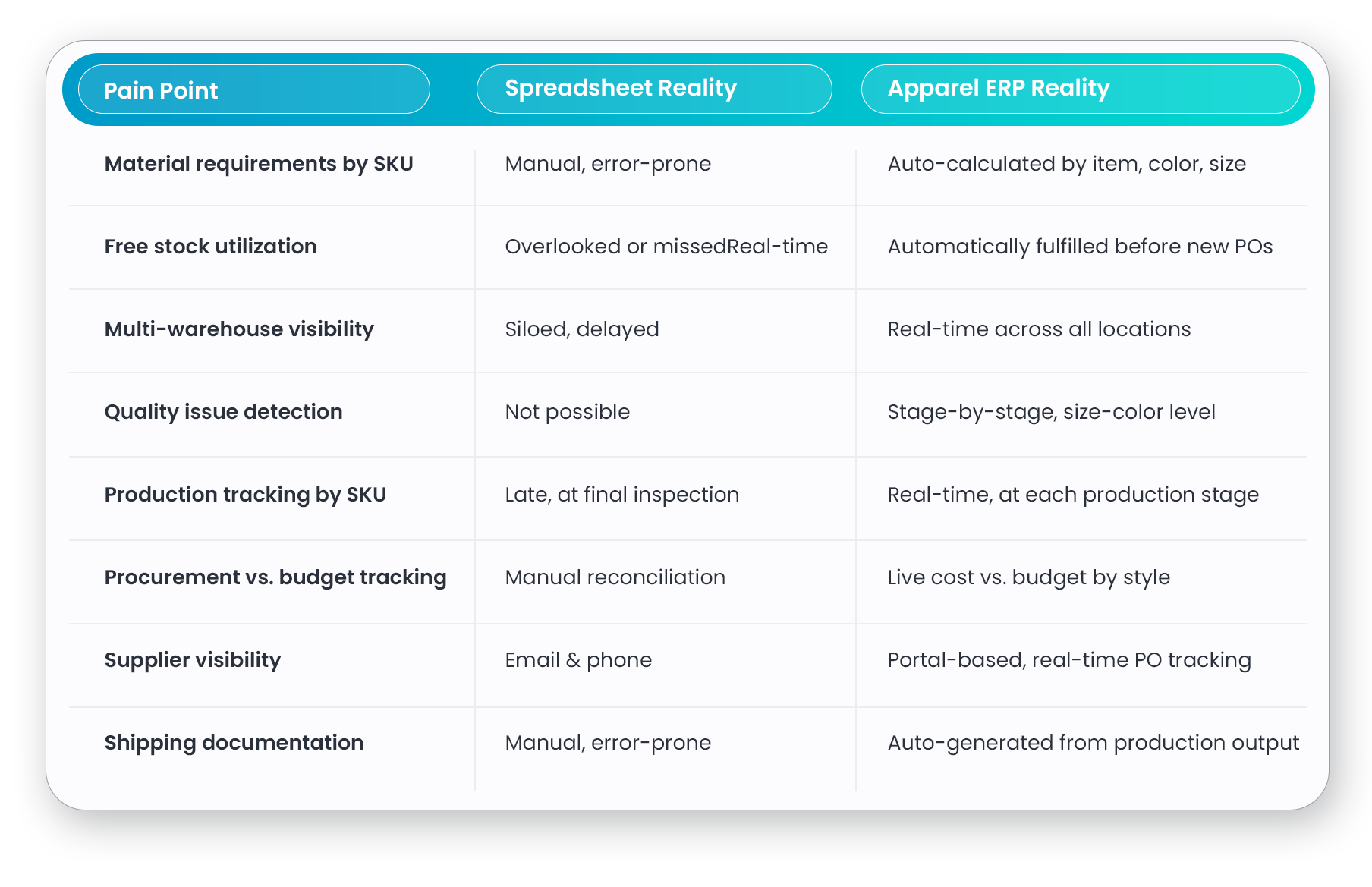
When you enter a customer order, the system immediately calculates material requirements at the SKU level — broken down by item, color, and size. It consolidates requirements across multiple orders and automatically generates purchase indents for any shortfall.
You can run your Material Requirements Planning (MRP) at multiple levels: by item, by item + color, or by item + color + size. The system checks existing free stock first, then identifies what needs to be procured — and for which specific SKU variant.
The result: no manual recalculation, no missed colorways, and no surprise material shortages when production starts.
Automated Free Stock Utilization
Before raising a new purchase order, the system checks whether existing free stock — including materials allocated to orders with later delivery dates — can fulfill the current requirement. It automatically fulfills material needs from available stock first, then flags genuine procurement gaps.
This eliminates the chronic overstocking problem that plagues manufacturers managing multiple orders manually.
Real-Time Inventory Visibility Across Warehouses
Every material movement — receipt, issue to production, return, transfer between locations — updates stock levels in real time. At any point, you can see exactly how much of a specific fabric, in a specific color, is available, committed, pending receipt, or in excess across every warehouse location.
This isn’t a report you run at the end of the day. It’s live visibility that lets production planners, procurement teams, and factory managers work from the same accurate picture simultaneously.
Production Tracking at the SKU Level
Production orders are tied to specific style-color-size SKUs. Every stage — cutting, sewing, finishing, packing — is tracked against the exact SKU breakdown. If a size run falls behind, it’s visible in real time, not discovered at final packing when it’s too late to recover.
Time & Action calendars track milestones against delivery commitments, with alerts when key thresholds are at risk — so your team can act before a delay becomes a shipment failure.
Quality Control Linked to SKU and Stage
Quality inspections are conducted and recorded at multiple production stages — inline, end-of-line, and pre-shipment. Defects and rejections are captured in real time, tied to the specific style, color, and size where they occurred.
This means a colorway-specific dyeing issue, or a size-specific fit problem is caught and addressed at the stage where it’s cheapest to fix — not discovered at final inspection when it’s too late.
Costing and Budgets Tied to SKU Variants
Cost sheets are built at the style level and can account for color and size-specific cost differences — different fabric consumption per size, different trim costs per colorway, different CMT rates for complex styles. Actual procurement costs are tracked against budgets in real time, so margin erosion by SKU is visible before it becomes a problem at month-end.
Supplier Collaboration and Procurement Visibility
Purchase orders — generated automatically from material requirements — are tracked through a supplier portal. You can see what’s been confirmed, what’s in production at the mill, what’s in transit, and what’s been received against each SKU’s material needs. Discrepancies at goods receipt — excess receiving, short receiving — are flagged automatically.
Shipping and Documentation by SKU Breakdown
Packing lists, shipping marks, and export documentation are generated from actual production output — with accurate SKU, size, and color breakdowns per carton. This eliminates the manual reconciliation between what was produced and what was packed that causes last-minute documentation errors.

 AI Solutions
 Contact Us