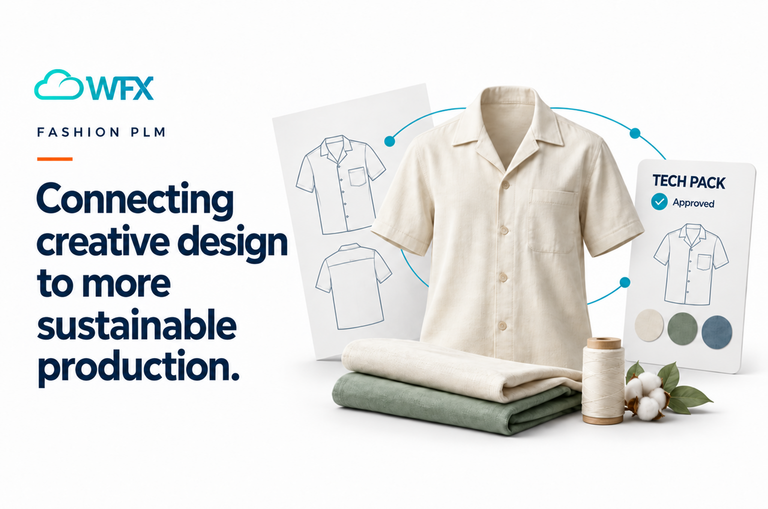
So what does a fashion PLM platform actually change for your brand? Here’s what matters most.
1. See your entire product lifecycle in one place
Good product development starts with knowing what’s going on, all of it, at a glance. And that goes right back to market research. When your whole team pulls from the same source of truth, it’s far easier to follow what customers actually want as a style moves from idea to finished product.
With WFX, the right people see the right information when they need it. Nobody’s chasing the latest version of a file or guessing which spreadsheet is current. You end up with cleaner collaboration and decisions that hold up.
2. Scale your collections without the chaos
Growth has a funny way of breaking things. More styles, more categories, more seasons, and suddenly a team that was coping fine by hand is underwater. The answer isn’t working longer hours. It’s a development process with enough structure to keep your ideas commercially grounded as the volumes climb.
This is where WFX PLM earns its keep. Brands on it see a 50% jump in their design-to-production ratio, which gives cross-functional teams room to scale across categories and seasonal collections without quality or speed taking the hit.
“WFX helped us improve the scale of how many products we were working on, increasing our style development by 300% in the same lead time, which was critical in growing our business.” Cole Mancini, VP, Product Development & Sourcing, Simply Noelle
3. Save time and slash product development costs
Your team’s time is worth a lot, so why burn it on data entry? With WFX PLM, brands spend 75% less time hunting for information and 60-80% less on manual entry. That’s hours handed back every week for the work that actually moves the business forward.
Then there’s the money side of it. Digital prototyping means fewer physical samples flying around the world, and WFX customers cut sample shipments by 25-50%. Lower costs, less waste. Tighter tech packs also mean fewer rounds of back-and-forth with suppliers, which speeds up iteration and tends to lift product quality along the way.
4. Built for your team, not just your IT department
Here’s an uncomfortable truth about software: it’s useless if nobody actually uses it. WFX PLM is built for the people who live in it every day, not just the IT team. The interface is clean and modern, shaped by years of design work in this industry.
What that means in practice is that someone with no technical background can sit down and get going without a two-week training course. They’re useful on day one.
5. Get to market faster with fashion PLM
In fashion, a slow launch can sink a whole season. WFX customers reach market 35% faster and push 3x-5x more development volume through the pipeline. Put simply, new collections land sooner, you grab more shelf space and mind share, and your competitors are left playing catch-up.
WFX also keeps you on top of the messy stuff: production schedules, supply-chain timelines, lead times, customs delays. Fewer nasty surprises means fewer launches knocked off course. (Want to go deeper? Here’s how PLM helps fashion brands reduce time-to-market.)
“WFX PLM helped us refine some of our own processes and streamline the product lifecycle and go-to-market strategy by reducing the back and forth with our suppliers.” Lekshmi Sudha, Senior Manager, IT Business Systems, Quay
6. Source smarter: sustainable sourcing and supplier collaboration
Sustainability gets thrown around a lot. But done properly, it’s also just good business. WFX PLM helps here by tightening up material sourcing, giving you a closer eye on vendors, tracking how suppliers actually perform, and holding quality steady through production.
When you work with dependable suppliers and build real relationships with them, quality stays consistent and you get far more visibility into labor practices and where materials come from. Sourcing covers a lot of ground, from textiles and trims like buttons, zippers and labels to newer fabrics, recycled polyester, and the certifications behind organic cotton. And because quality checks run at every stage, including during and after assembly, products hit standard while waste stays down. Good for the planet, good for the books.
7. Make decisions backed by real data
Smart calls need solid data behind them. WFX PLM lets you dig into analytics from your own operations to catch trends early, see where you’re leaking time or money, and find openings you’d have missed otherwise.
Your product managers and designers can test concepts against what customers expect and where trends are heading, while the numbers sharpen your pricing, resourcing and margins. Once a product is out, analytics show you what landed so you can adjust the next move. The BoF-McKinsey State of Fashion report found that 50% of fashion executives now see consumer product discovery as a key use case for AI, so working this way is fast becoming table stakes.

 AI Solutions
 Contact Us