1. Evaluate your Business Needs and Problem Areas
Before investing time or money, take stock of how your business actually functions. Understand how your teams are structured, how they collaborate, and where they lose time.
For most fashion businesses, the biggest time killers are documentation, vendor communication, and raising purchase orders. A PLM built for the fashion industry should streamline your supply chain for speed and accuracy while minimizing lost profit. Factor in your growth strategy and expansion plans too, so the platform you pick does not become a constraint as the company scales.
2. Match Features and Functionalities to Your Needs
Don’t be tempted by the cheapest option – the best PLM for your business is the one that delivers what you need. Take some time to write down what you want to achieve and then separate the must-haves from the nice-to-haves. A good PLM will do more than just track inventory – it should streamline sourcing and manufacturing across the supply chain. And don’t forget about the time factor – how easy is the system to use day to day and how much support will you get?
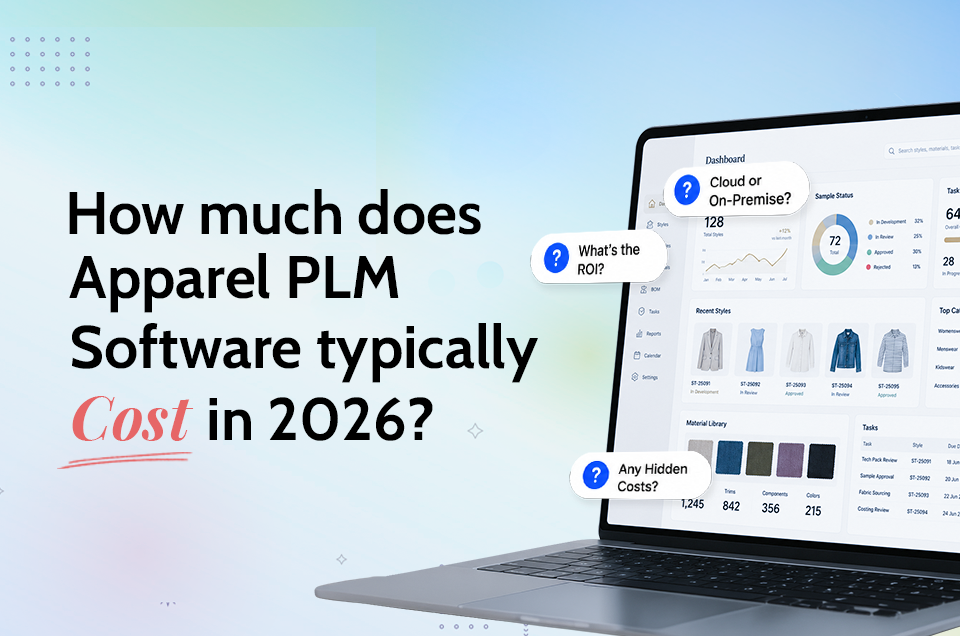
3. Cloud vsOn-Premise: Which Is Better for Fashion PLM?
For most fashion brands and manufacturers, cloud-based PLM is the way to go. Here’s why:
- Lower upfront cost – you don’t need to shell out for hardware or IT staff
- Greater flexibility – you can scale up or down as needed
- Stronger connectivity – teams can work seamlessly online and off
- Automatic updates – new versions roll out automatically
If you’re already running an on-premise system, weigh the costs of switching against the long-term benefits of flexibility and maintenance savings.
4. Check User-Friendliness and Ease of Access
Operational transformation influences the entire organization, and the objective of PLM implementation is enhancing daily productivity for personnel. Involve both leadership stakeholders and the individuals who will interact with the platform regularly to validate the interface delivers responsiveness, clarity, and navigational simplicity.
For fashion industry professionals, a compelling visual presentation can prove equally significant as the underlying functionality. Design teams require an interface aligned with their creative thought processes, whereas the financial analysis department may require cost documentation structured according to specific conventions. Maintaining comprehensive stakeholder engagement throughout evaluation also facilitates considerably smoother organizational transition.
5. Assess Onboarding and Support
Implementation takes time. A full PLM rollout typically runs around five to six months and depends on professional support from the provider, so onboarding quality should weigh heavily in your decision.
The best fashion PLM companies offer full-service packages that include installation and training. Before you buy, ask:
- Does the provider have experience with companies in your industry?
- How long does implementation usually take?
- Will they support your team in person during onboarding?
- Can they share case studies that show the process end to end?
- What ongoing support do they offer, and are they reachable by phone?
- How strong is their after-sales service?
6. Review the Provider’s Security Standards
Security is non-negotiable for a fashion PLM -especially for apparel companies who are sitting ducks for data thieves. Their intellectual property is basically the lifeblood of their business. So your PLM needs to not just protect it – but lock it down tight.
Look for security certifications, years under their belt, and a good reputation in the market. I mean, WFX has got ISO 27001 certification, which says to me they’re taking info security super seriously. For you, that means they’ll be safeguarding the works – employee and client info, brand image, all that private stuff.
7. Prioritize Customizability and Personalization
Let’s face it – you’re in the fashion industry, so your business is never going to be like anyone else’s. That means you need a PLM that can be tailored to your specific needs – one that’s flexible and adapts to your product cycle and workflows. And let’s not forget automation and integration – if that’s what you need, that’s what you should be looking for.
If you need in-depth analytics and insight reports, or if your product cycle has loads of different stages, your PLM should be able to handle all that for you. And doable in a way that makes sense to your business, too.
8. Look for Ease of Integration
Whatever your size, you likely already run tools such as NetSuite, an ERP, or Adobe Illustrator. Your PLM must integrate cleanly with these systems to avoid disruption and duplicate work.
WFX PLM, for instance, pulls and pushes product data, attributes, images, costing plans, and orders across connected systems. You can drag and drop Adobe AI files to build tech packs. As the only fashion PLM with a “Built for NetSuite” certified connector, WFX keeps the two platforms in sync, so a change on one updates automatically on the other.
9. Use a Demo or Free Trial to Validate Your Choice
The best way to know whether a platform is for you is to try it out for yourself. You wouldn’t buy a car without taking it for a spin, would you? Same with your PLM – you need to see it in action and know it’s the right fit for you.
Use the demo to check how easy it is to use in real life, if it’s got all the features you need, and if it can be tailored to your workflows. Ask your open questions and get some clarity before you make a final decision. And WFX offers free demos of their fashion PLM, so that’s worth checking out.