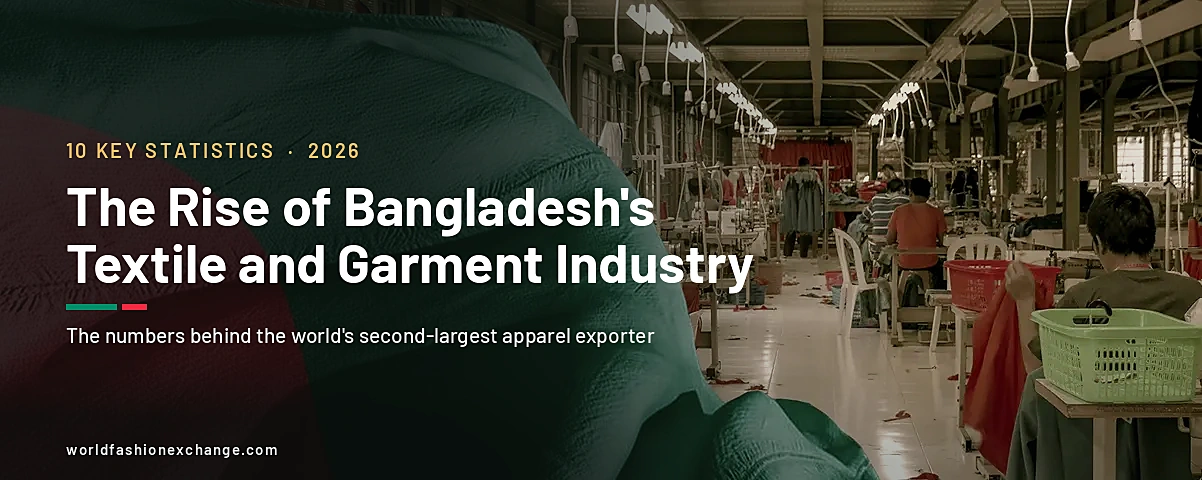
1. Bangladesh is the world’s second largest apparel exporter
Only China ships more clothing than Bangladesh. Dhaka currently commands roughly 6.9% of the global apparel market. While China’s share sits in another league past $165 billion, Vietnam is hot on Bangladesh’s heels at nearly $34 billion, capturing a bit more of the gap each year. Second place stopped feeling safe a while back, and nobody in the industry pretends otherwise.
2. RMG exports reached$39.35 billionin FY2024-25
Garment exports in fiscal year 2024-25 climbed to US $39.35 billion, an 8.84% year on year increase according to the Export Promotion Bureau. Set against the soft orders and macro disruptions that came before it, this represents a textbook recovery. Calendar year 2024 told a similar story of resilience, wrapping up at $38.48 billion (7.23% above 2023).
3. Garments make up over 80% of the country’s total exports
Take ready-made garments (RMG) out of the picture, and the national export economy heavily shrinks. RMG anchors roughly 81% of Bangladesh’s $48 billion total export earnings. This concentration is the source of the sector’s immense political clout, but it is also its greatest vulnerability. Cutting this structural dependence by diversifying into high value items is the strategic project running quietly beneath everything else.
4. The European Union is the largest export market
A lot of legacy trade write ups get this wrong: the EU, not the US, is Bangladesh’s largest market. Taken as a bloc, the EU buys about half of all RMG exports, totaling $19.71 billion in FY2024-25. Germany leads the buying, followed by Spain, France, the Netherlands, and Poland. Much of that volume traces directly back to duty free access under the EU’s Everything But Arms (EBA) scheme.
5. The United States is the largest single country buyer
Break the EU back into individual nations, and the United States leads on its own, accounting for US $7.54 billion (19.18% of exports) in FY2024-25. However, US tariff policy has dramatically shifted this traffic over the last year.
Following highly volatile reciprocal rates in 2025, the historic US Bangladesh Agreement on Reciprocal Trade (ART) signed in February 2026 stabilized the reciprocal surcharge at 19%. Crucially, the pact unlocked a 0% reciprocal tariff pathway for garments utilizing verified US produced cotton and man made fibers. In an industry where raw fiber origin now dictates duty advantages, supply chain transparency is no longer optional, it is a core margin driver.
6. The industry employs more than four million people
Direct factory employment runs to an estimated four million plus people, most of whom are women. When you count dependents and the wider spinning, weaving, and logistical supply chains, the livelihoods tied to the sector climb into the tens of millions. Nothing else in the formal economy comes near it. This is why RMG is universally recognized as the engine of Bangladesh’s poverty reduction.
7. Women make up the majority of the workforce, but the share is slipping
Women built this industry. In its early decades, they comprised close to 80% of the workforce. Today, that figure has slid to between 52% and 60%. The share is dropping as automation strips out low skill entry roles and a younger generation looks elsewhere for employment. This shift is exactly why the transition to “smart factories” matters: the goal must be lifting workers into higher value technical roles rather than out of a job entirely.
8. Knitwear is outpacing woven garments
Knitwear outgrew woven items last fiscal year, marking a 9.73% increase against woven’s 7.82%. Cotton knits by themselves represent about 56% of RMG export value. This specialized, deeply integrated cotton knit base is the exact reason global buyers think of Bangladesh first for high volume T shirts, polos, and sweaters. Because fabric alone eats up 60% to 70% of a basic style’s manufacturing budget, getting your raw material costing wrong will collapse a margin before production even starts.
9. Bangladesh leads the world in green factories
This is the milestone that has quietly rewritten Bangladesh’s global reputation. No country on earth possesses more LEED certified green factories, reaching roughly 284 facilities by mid 2026, with over 120 rated at the elite Platinum level. In fact, more than half of the top 100 highest scoring LEED buildings on the planet stand on Bangladeshi soil. As the EU tightens its environmental and ESG rules, this infrastructure transforms from a marketing point into a strict commercial advantage.
10. BGMEA is targeting$100 billion in exports by 2030
The BGMEA is holding firm on its target: US $100 billion in apparel exports by 2030. Reaching this milestone is impossible by simply stitching more of the same basic cotton T-shirts. It requires an aggressive pivot into synthetics, man made fibers (MMF), and technical performance apparel, alongside winning non traditional markets like Japan, Australia, and India. This is fundamentally a design and product development challenge, putting speed to market tools right at the center of future factory operations.

 AI Solutions
 Contact Us