Apparel and Textiles Warehouse Management System (WMS): From Fabric Rolls to Finished Goods

Learn moreright arrow

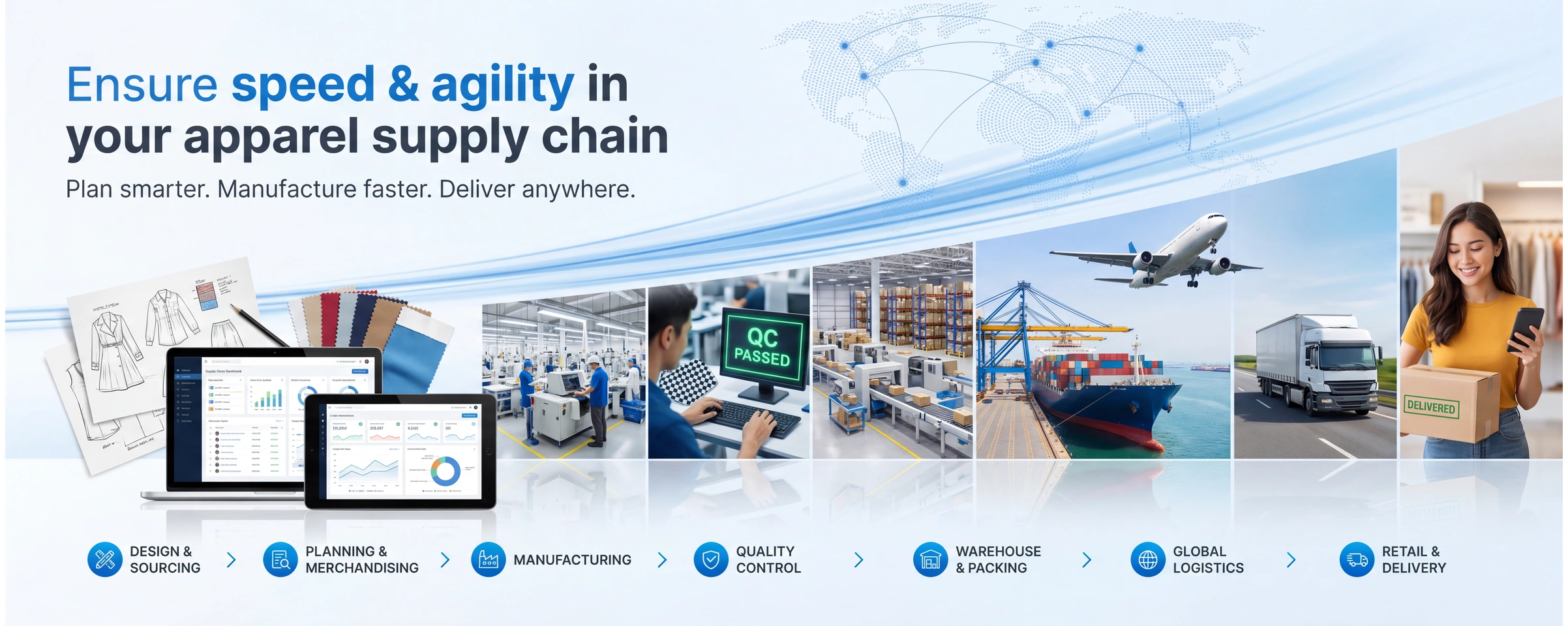
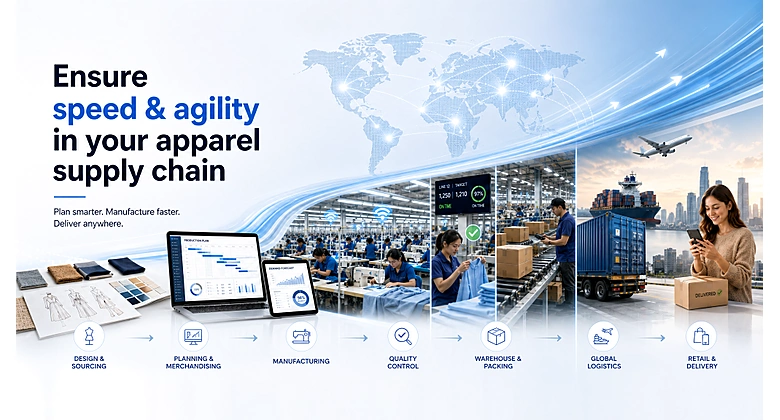
How to ensure speed & agility in your apparel supply chain

14 mins read • 31st, Dec 2025

Quick answer:

The apparel supply chain is the end-to-end flow that moves a garment from design to customer. It covers raw material sourcing, production planning, manufacturing, quality control, and delivery. To make it fast and agile, forecast demand early, see every stage in real time, automate your time and action tracking, and get teams and suppliers on one platform such as WFX Apparel ERP. 

Speed is not a bonus in fashion anymore. It is the whole game. Ship on time or miss the window. Catch the trend or watch it pass. Win the next order or lose it to the factory down the road. Brands keep squeezing lead times, and the manufacturers who hold on to the work are simply the ones who can keep up. Without letting quality or cost slip. 

Trouble is, delays are everywhere. Weak planning. Systems that will not talk to each other. Time zones. Feedback that takes three days when it should take three minutes. Specs nobody nailed down. So this guide gets practical. What the apparel supply chain actually is, how it moves stage by stage, where the time leaks out, which numbers to watch, and what to do about all of it. 

What is the apparel supply chain?

The apparel supply chain is the whole network of people, processes, and information that carries a garment from an idea to a customer’s hands. Sourcing raw materials and fabric. Planning production. Cutting and sewing. Checking quality. Storing stock. Shipping the finished products. All of it lives inside that chain. 

Fashion supply chain management is the work of planning and running that flow so the right product gets made at the right cost and lands on time. Sounds simple on paper. It is not. The global fashion industry sprawls across multiple countries and dozens of suppliers, and product cycles turn over fast, so one hold-up in one stage almost never stays put. It shoves everything behind it. 

The key stages of the apparel supply chain

Want to see where time gets won or lost? Start with the stages a garment passes through. 

  • Design and product development. Concepts, tech packs, specs. All created and signed off here. And what you decide at this point quietly sets the cost, the lead time, and how buildable the style will be later. 
  • Raw material sourcing. Fabric, trims, components, all sourced and purchased. This is one of the longest levers on lead time. Order late here and you pay for it everywhere else. 
  • Sampling and approvals. Prototypes and pre-production samples get made and approved. Slow rounds eat schedules, and they do it quietly. 
  • Production planning. Orders scheduled against real capacity and material availability, so the line runs smooth and hits its dates. 
  • Manufacturing. Cutting, sewing, finishing, assembly. Materials turn into garments. 
  • Quality control. Inline and final checks catch defects before goods leave the floor. That is how quality standards actually hold. 
  • Warehousing and inventory management. Stock and materials stored and tracked, inventory levels kept in step with demand. 
  • Logistics and delivery. Goods move through transportation networks to the buyer or distribution centre. On-time delivery closes the loop. 

Notice how each stage leans on the last. Sampling slips, production slips, shipping slips. That domino run is the whole reason visibility across the entire flow beats watching one stage at a time. 

Speed versus agility: what is the difference?

People swap these two words around like they mean the same thing. They do not. And a strong apparel supply chain needs both. 

Speed is how fast you move a product from design to delivery when the plan holds. Shorter lead times. Fewer bottlenecks. Dates you hit, over and over. 

Agility is the other half. It is what you do when the plan breaks. A demand spike. A supplier who blows a date. A fabric shortage. A trend that flips overnight. Agility is what lets you take that hit and keep the schedule standing. 

Put plainly, speed keeps you efficient and agility keeps you upright. The fashion companies running both catch trends before their rivals do, and they ride out supply chain disruptions with far less damage to margins and to customer satisfaction. 

Why do speed and agility matter in the fashion supply chain?

Demand in fashion is volatile and trend led. A trend can turn inside one season. And shoppers still expect delivery quick and reliable. An agile supply chain keeps pace with that market demand. It gets product out sooner and flexes production volumes the moment a forecast moves. 

Here is where it actually pays off. 

  • Speed to market. Product on the shelf while the trend is live sells at full price. Late product gets marked down. Simple as that. 
  • Margin protection. A schedule that holds means no panic air freight, and none of the discounts a late delivery drags out of you. 
  • Customer satisfaction and retention. Buyers who can trust your dates come back. And that repeat business beats any one order. 
  • Resilience. Supplier slips, demand jumps, and visibility plus flexible planning let you reroute before it turns into a fire. 
  • Sustainability and compliance. Tighter planning cuts overproduction and waste. That feeds responsible sourcing, and it eases the regulatory pressures now leaning on the whole industry. 

What causes delays in the apparel supply chain?

Dig into late orders and the same suspects keep showing up. Clear these, and a slow, reactive chain starts to actually move. 

  • Poor planning and weak demand forecasting. Miss the forecast or leave planning too late and material orders slide, while production gets jammed into a window that was never going to work. 
  • Fragmented systems. Design, sourcing, purchase, and production scattered across separate spreadsheets and tools. Nobody holds one current view of an order. 
  • Communication hurdles and time zones. Buyers, factories, suppliers, all spread across regions. Days vanish into slow replies and updates that never quite sync. 
  • Mismatched quality expectations. Fuzzy specs breed reworks and re-inspections, and they hit late, right when time is hardest to win back. 
  • Limited visibility. No live status means a problem only surfaces once the order is already behind. By then there is no room to react. 
  • Manual, duplicated data entry. Rekey the same numbers across systems and you get two things: lost time and fresh errors that spread. 

How to ensure speed and agility in your apparel supply chain

1. Plan demand and production early

Speed gets built long before anyone touches a sewing machine. Nail demand forecasting. Plan production properly. Do both and you lock in raw material sourcing and capacity ahead of time, instead of scrambling when the order lands. Schedule against realistic lead times and the capacity you truly have. Do that, and the bottlenecks that usually push shipments late never even form.

2. Get end-to-end visibility with a Time and Action calendar

The backbone of supply chain management in apparel is a well-run Time and Action (T&A) calendar. Time is about how fast goods get out the door. Action is everything else: naming the tasks, planning them, doing them, then checking they got done the way they should have. 

A T&A calendar follows every event in the fashion lifecycle, from that first design and inspiration stage all the way to shipment tracking, on one screen. Teams see what is due, when, who owns it, how long it should take. A manager can catch a slip while it is still tiny, well before it grows into a missed delivery. WFX ERP’s T&A module hands you that visibility across every time-sensitive process, so decisions come faster and orders land when they are meant to.

3. Automate tracking so people stop rekeying

Manual data entry is a tax on speed, and it breeds mistakes. Automate your time and action tracking and the double work disappears, replaced by live visibility into styles, quantities, and order status. 

In WFX ERP, the second a customer order arrives, it can fire T&A tracking templates built around that order. Every task tied to it, captured in a few clicks. Less time babysitting orders. Sharper delivery forecasts. Fewer costly slip-ups. And the system keeps you compliant by tracking critical dates and handling change requests, so none of it hangs on someone’s memory or a buried email.

4. Balance inventory with demand-driven planning

Too much stock locks up cash. Too little means stockouts and late orders. Good inventory management and inventory control walk that line by matching inventory levels to real demand and to your production schedules. 

Run a just-in-time inventory approach on accurate data and materials turn up when the line needs them, instead of sitting idle or arriving late. Live insight into stock levels, sales volumes, and lead times is what lets you make the call with confidence, and keep things moving without carrying dead weight.

5. Get suppliers and teams onto the same page

Agility falls apart the moment people work off different versions of the truth. Put design, purchase, production, and quality on one platform and the communication hurdles and time zone gaps stop wrecking timelines. Everyone sees task status, who is holding what, how far along it is. Departments stay in step and honest about each other’s deadlines. 

That shared view lifts supply chain performance in a very ordinary, very useful way. You can see exactly where a task is stuck, then move work or people before it jams up the next stage. 

6. Digitise the flow from order to shop floor 

Speed leaks out every single time information gets rekeyed or dropped between stages. Tie order details, material requirements, production schedules, and shop-floor progress into one system and the data stays accurate from the moment an order is confirmed. Better still, when the factory floor reports progress back into that same system in real time, planners see actual output against plan and deal with a delay while it is happening. Not three days later.

7. Build agility in for disruptions and sustainability

Supply chain disruptions are not an if. They are a when. Being agile means you already hold the visibility and the planning tools to reroute, resequence, or reprioritise the second a supplier slips or demand shifts. 

There is a sustainability thread running through this too. Responsible sourcing and sustainable practices are now part of what customers expect and what regulators demand. Keep your raw materials, suppliers, and production data in one place and it gets far easier to source sustainable materials, prove compliance, and cut waste. All without letting a single delivery date slide. 

Which metrics should you track to measure supply chain performance?

You cannot fix what you never measure. These are the numbers apparel manufacturers watch to keep speed, agility, and overall supply chain performance honest: 

Metric  What it measures 
Lead time  The total time from order confirmation to delivery. Your headline speed number. 
On time in full (OTIF)  The share of orders that arrive complete and on the agreed date. 
T&A adherence  How closely actual task completion tracks the planned Time and Action calendar. 
On-time material delivery  Whether raw materials and trims land when production needs them. 
Capacity utilisation  How well production capacity is being used against plan. 
Work in progress (WIP)  How much is in production right now, which flags where things are backing up. 
Right first time  The share of output that clears quality control without rework. 
Sample approval turnaround  How quickly samples move through their rounds to sign-off. 

Track these in one system, not across a stack of spreadsheets, and the raw data starts throwing early warnings. You act before a delay ever reaches the customer. 

Traditional versus agile apparel supply chain

The gap between a slow chain and a fast one nearly always comes down to how information moves. Here is how a spreadsheet-driven setup stacks up against an ERP-powered, agile one: 

Dimension  Traditional (spreadsheet      based)  Agile (ERP powered) 
Visibility  Scattered across files and inboxes  One real-time view of every order 
Planning  Manual and reactive  Data driven and planned ahead 
Tracking  Updated by hand, often stale  Automated from live order data 
Communication  Email chains across time zones  Shared platform with clear task ownership 
Response to disruption  Slow, only once problems show  Fast, with early warnings and rescheduling 
Data accuracy  Prone to rekeying errors  Consistent from a single source of truth 


How WFX Apparel ERP powers a faster supply chain

WFX ERP pulls production planning, purchase, the Time and Action calendar, inventory, and shop-floor tracking onto one cloud platform built for apparel manufacturers. No more duct-taping spreadsheets and half-connected tools together. Your teams work from one source of truth that shows exactly where every order stands. 

  • Time and Action calendar for a full view of every time-sensitive process on one screen.
  • Production planning to schedule orders against real capacity and material availability.
  • Purchase and inventory management to line up material ordering and stock with what production actually needs.
  • Warehouse management to keep inventory accurate and moving.
  • Shop-floor and MES tracking to compare live output against plan and catch delays early.

Put it together. A supply chain that plans faster, watches easier, adapts quicker. That is the real foundation for on-time delivery that never cuts corners on quality. WFX is trusted by Gokaldas Exports, Shahi Exports, Aquarelle, Bhartiya, Texport, and 600+ apparel businesses across 50+ countries. 

Frequently asked questions

What is the apparel supply chain?  

Every process that moves a garment from concept to customer. Design, raw material sourcing, sampling, production planning, manufacturing, quality control, warehousing, then getting the finished product out the door. 

What are the main stages of the apparel supply chain?  

Eight of them. Design and product development, raw material sourcing, sampling and approvals, production planning, manufacturing, quality control, warehousing and inventory management, then logistics and delivery. 

Why is speed important in the fashion supply chain?  

Fashion is trend led and demand swings fast. Move quickly and you catch trends, hit the dates buyers now expect, protect your margins, and win the next order. Move slowly and you lose all four. 

What is the difference between speed and agility in a supply chain? 

 Speed is how fast you move a product from design to delivery when the plan holds. Agility is how fast you adapt when it does not, say a demand spike or a supplier who misses a date. You want both. 

What causes delays in apparel production?  

Usually a handful of things. Weak planning and demand forecasting. Systems that will not talk to each other. Communication gaps across time zones. Fuzzy quality expectations. Thin visibility. And rekeying the same data by hand. 

What is a Time and Action (T&A) calendar in apparel manufacturing?  

It tracks every event in the production lifecycle, design through shipment, on one screen. You see what is due, when, and who owns it. That is how teams stay on schedule and catch bottlenecks early. 

Which metrics measure apparel supply chain performance?  

Lead time, on time in full (OTIF), T&A adherence, on-time material delivery, capacity utilisation, work in progress, right first time, and sample approval turnaround. 

How does apparel ERP software improve supply chain agility?  

It puts production planning, purchase, inventory, and time and action tracking on one platform. That live visibility is what lets manufacturers plan ahead, automate tracking, and pivot fast when demand or supply shifts. 

How can manufacturers make their fashion supply chain more sustainable? Keep raw materials, suppliers, and production data in one place. It makes responsible sourcing, sustainable materials, compliance, and cutting waste far easier to manage. And you do it without missing delivery dates. 

Key takeaways

  • Eight connected stages carry a garment from design to customer. Slip on one and the rest slip with it. 
  • Speed compresses lead times when the plan holds. Agility keeps you steady when it does not. You want both. 
  • Most delays trace back to weak planning, fragmented systems, poor communication, and thin visibility. 
  • The real levers are early demand forecasting, a Time and Action calendar, automated tracking, and demand-driven inventory. 
  • Watch the right metrics, run the chain on one connected platform like WFX Apparel ERP, and visibility turns into on-time delivery. 

Conclusion

A fast, agile apparel supply chain does not come from working harder. It comes from planning sooner, seeing clearly, letting the system carry the routine load, and keeping teams and suppliers aligned. WFX ERP’s Time and Action calendar and connected supply chain tools give apparel manufacturers all of that, so orders ship on time and quality never takes the hit. 

Read Our Blogs

...
Why Fashion Brands Need an Industry-Specific ERP Instead of a Generic One

Fashion ERP vs. Generic ERP: Why Apparel Brands Need Specialized Software

Read More
...
Leveraging PLM for efficient fashion product development

Enhancing fashion product development with efficient Fashion PLM utilization and optimization.

Read More
...
How PLM Software Helps Fashion Brands Reduce Time-to-Market (2026 Guide)

See how Fashion PLM software helps apparel brands reduce time-to-market by 30–35% in 2026.

Read More