Apparel and Textiles Warehouse Management System (WMS): From Fabric Rolls to Finished Goods

Learn moreright arrow

The Ultimate Guide to Bill of Materials in Apparel Industry

8 mins read • 5th, Feb 2026

Quick Answer

A Bill of Materials (BOM) in apparel manufacturing is a structured list of all fabrics, trims, components, and quantities needed to produce a garment, used across design, sourcing, costing, and production processes.

Introduction

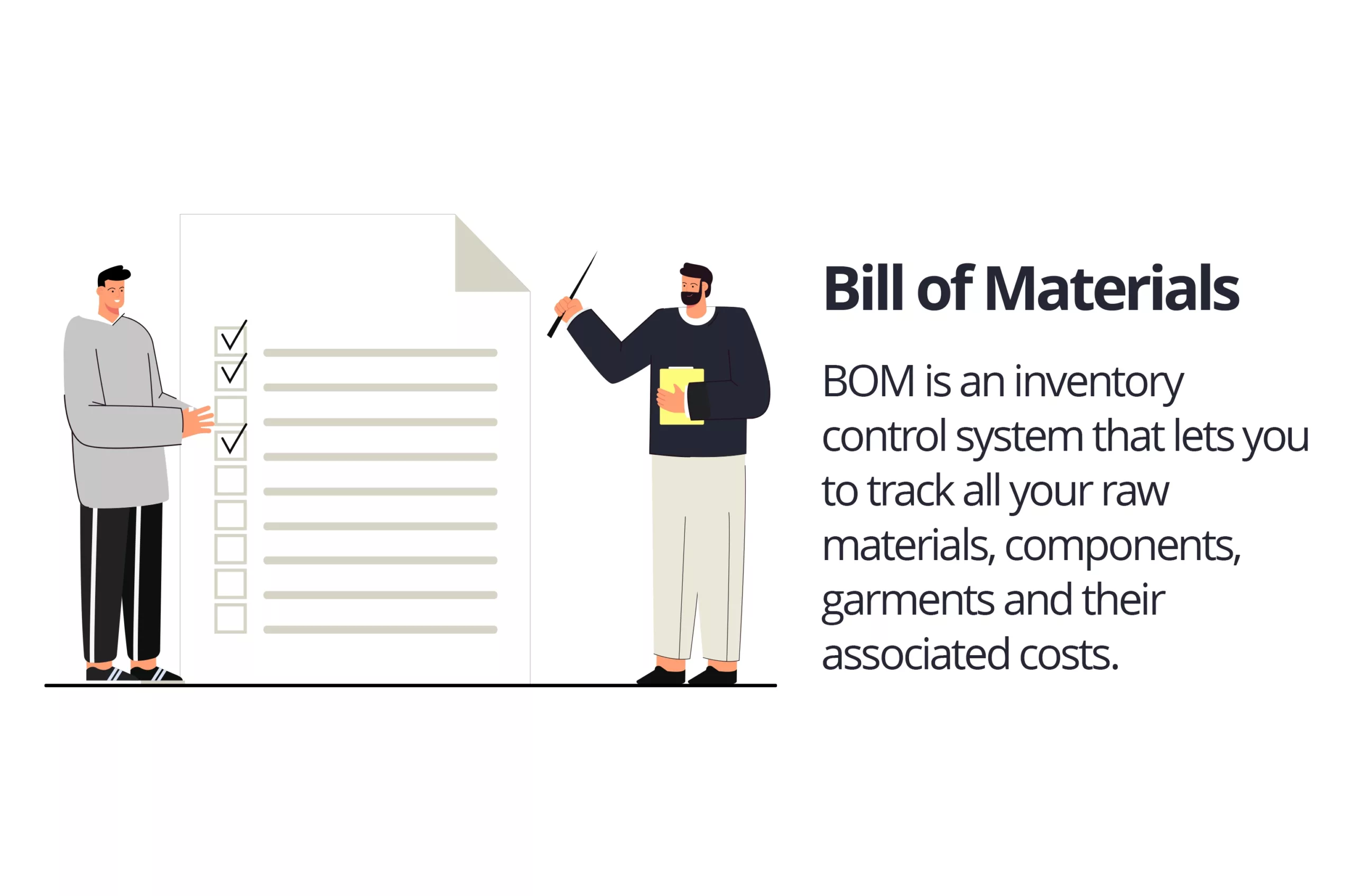
A Bill of Material is a basic tool that every apparel business should use to boost efficiency. The simplest way to explain it is as an inventory control system that allows you to track all your raw materials, components, garments and their associated costs. It can also serve as an important record when dealing with suppliers who might require it from you from time-to-time. 

To start with, let’s take an apparel manufacturer as an example: Say you want to sell t-shirts and hoodies. You would need fabric for the shirts and hoodies which will be cut into multiple pieces (front, back etc.) Then there are buttons and zippers which are also manufactured by another company. All these materials come together at your factory where they are assembled into complete products like t-shirts or hoodies that are ready for shipping. 

A Bill of Material tells you what materials are needed to make a product. It also tells you how many pieces of each material are required. 

What is Bill of Material (BOM) in garment industry?

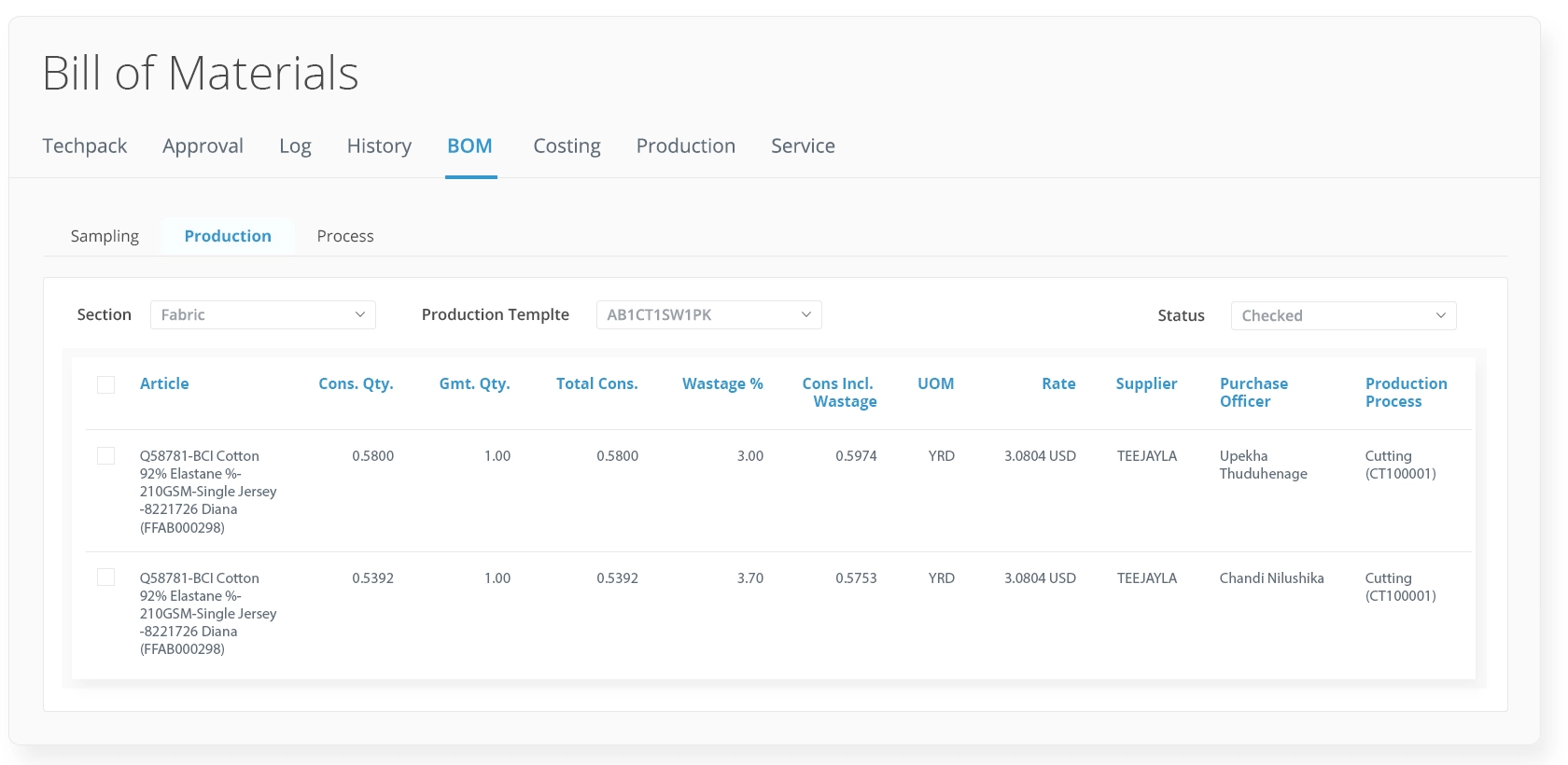
BOM in garment industryA Bill of Material is a detailed list of all the materials, trims and their quantities that are required to make a product. It’s essentially an inventory list, but it serves far more functions than just keeping track of what materials need to be ordered or manufactured. 

The BOM is used for tracking purposes and to ensure that the right quantity of materials is ordered for production, as well as for planning purposes. It helps you keep track of what components are being used in production and when they need reordering. 

BOM also provides you with an understanding of how many parts each component will be used to make during production. This lets you figure out your estimated costs ahead of time. It allows you to choose fabrics or materials keeping them affordable without losing quality or style. 

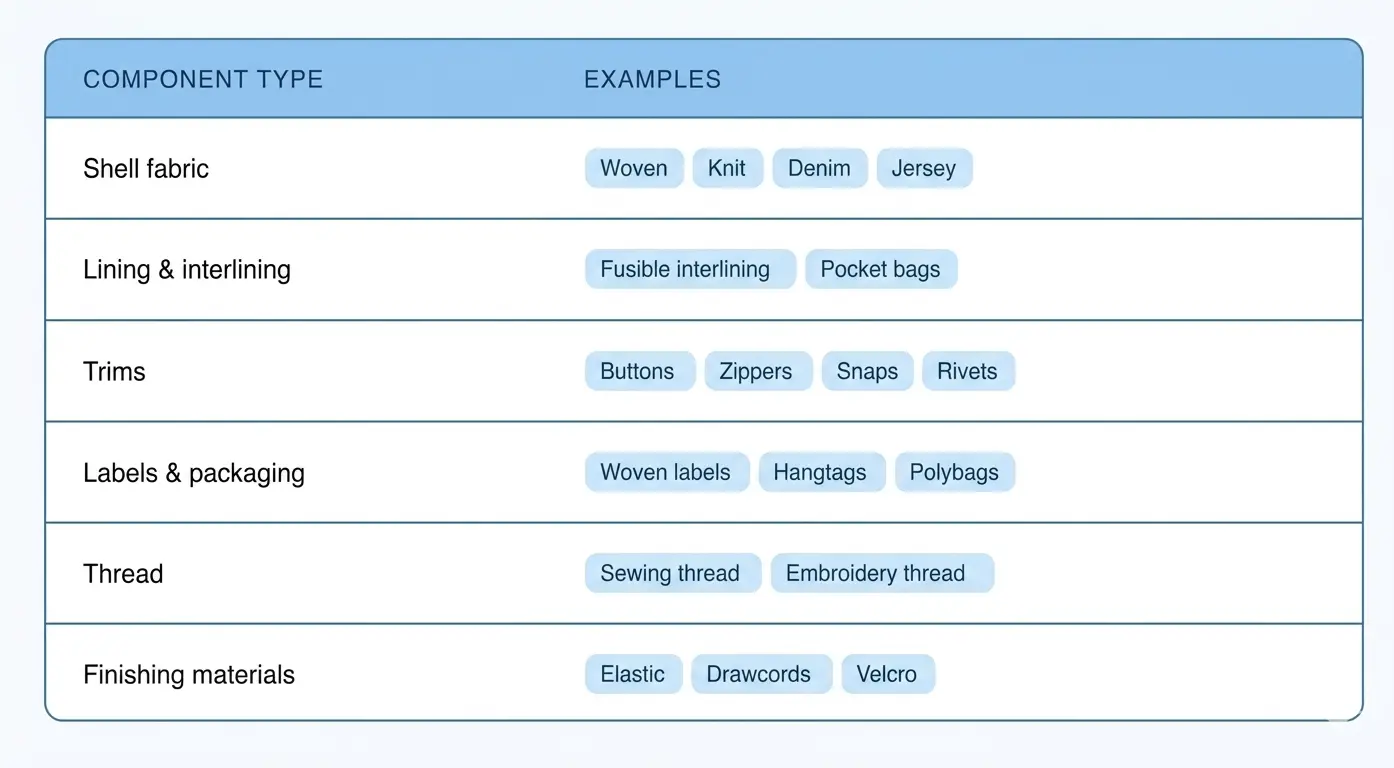
What does a garment BOM typically include?

Garment BOM

A BOM works alongside with the tech pack and costing sheet to create a shared, up-to-date record of product details for brands and factories. 

Why is a Bill of Material important for apparel businesses?

Apparel businesses

It is important to understand the four main reasons why a Bill of Material is so critical in the garment manufacturing process. 

Reduce time taken in production: A good BOM helps to reduce the time taken in production by identifying each item and its quantity. This allows you to manage your schedule better and get your product delivered on time, which is a huge advantage when compared with competitors who do not have good BOMs. 

Reduce cost of production: If a company has a good BOM, it means that they can plan their budget better as they will know how much they need to spend on materials, components and labor required for each garment type. Also, if there are any changes made during the process, then the updated version will be available for all team members which eliminates any confusion about what needs to be done next. 

Reduce inventory of finished goods: A good BOM will help you to reduce your inventory of finished goods as it allows you to plan which items need to be produced first and then send them out to the market. This is especially useful if there are seasonal changes in demand and also when a product’s lifecycle comes to an end. 

Reduce waste: A good BOM will help you to reduce the amount of waste that is generated during the production process. If there are any changes made in the design, then only those items which need updating will be affected. This reduces the number of materials used and saves on costs. 

Tips to make a good and accurate Garment BOM

If you are working on a garment product, here are some tips to help you make a good BOM: 

  • Keep it simple. Make sure to use the same terminology across the business. This way, everyone will understand what is being talked about when someone mentions a tag or pocket. 
  • Use consistent naming convention while assigning names to individual components in BOMs. For example, if you have decided to use a 2-digit numbering system (01, 02 etc) consistently throughout your business then do that for all components as well. 
  • Stick with standard abbreviations whenever possible. For instance, if you decide to use “AP” to mean Assembly Process or assembly line, keep using “AP”. Avoid switching it to something else, like “AC” or “AS.”  
  • Use a consistent format. To do this, create an outline or table which has rows and columns representing each component and its attributes such as size or color code. 
  • Make the information clear and straightforward. Whoever needs to use the BOM should understand what it says without needing to ask questions or dig into other documents or notes to make sense of it.  
  • Make sure it’s easy to update. Having an easy way to update data automatically makes things easier overall and allows you to be flexible when changes come up. 

Confused about ERP? Get Our Buyer’s Guide

    Benefits of using WFX to create and manage BOMs

    By using WFX PLM’s in-built module to create and manage BOMs, you can: 

    • Remove the need for manual preparation and management of BOMs which saves time, money and human errors 
    • Share BOMs directly with your factory through the system, which means that they can continue working on the data even when your team is unavailable 
    • Easily access information about each component in your finished garment 
    • Create accurate BOMs from scratch or update existing ones with just a few clicks 
    • Track any changes made to BOMs automatically so it’s easy to identify discrepancies or missing information 
    • View and manage BOMs within a range of different contexts, such as by product type or category 
    • Make it easy for your team to access all relevant information about each component in the garment at the same time 

    Conclusion

    The Bill of Material serves a vital function in the apparel industry. It enables businesses to monitor stock and identify required materials for product creation. This knowledge assists them in determining how to manufacture products that are either more sustainable or more cost-effective to satisfy their customers’ requirements. 

    Frequently Asked Questions (FAQ)

    What does BOM stand for in the garment industry?  

    BOM stands for Bill of Materials. It is a complete list of fabrics, trims, labels, and components, with quantities and costs, required to manufacture a single garment style. 

    How is a BOM different from a tech pack? 

    A tech pack explains all the garment details, like how it’s made, its measurements, grading, and stitching steps. A BOM focuses on the materials and components showing their quantities and costs. Most of the time, the BOM is either part of the tech pack or connected to it. 

    How does a BOM differ from a costing sheet? 

    A BOM shows the materials needed and the amounts. A costing sheet uses the BOM to figure out the final FOB or wholesale price by adding costs for materials, labor, overheads, and margins. While the BOM provides the base data, the costing sheet processes it to calculate costs. They connect but are not the same file. 

     How many BOMs does one garment style need? 

    Most garment styles need at least two. The sampling stage uses a development BOM, while a production BOM gets finalized after the fit is approved. If a style has several color options with different trims or fabric details, each color might need its own BOM. 

     What if a BOM is wrong during production?  

    A wrong BOM causes incorrect material orders. This can lead to not having enough materials, which could stop production, or having too much piling up inventory. If a mistake in the BOM leads to issuing the wrong material, it might make garments fail quality checks. This could result in extra costs to fix the mistakes or even canceled orders. 

     Is it possible to manage apparel BOMs with spreadsheets? 

    Spreadsheets work fine for smaller setups but fail to keep up once things grow bigger. Version control is the biggest issue. When a brand deals with hundreds of styles across several factories and seasons, relying on emailed spreadsheets creates confusion. Teams might end up working with outdated or mismatched BOMs. A PLM system addresses this problem by offering a single live version of the BOM that everyone can access and rely on. 

     How does a PLM system make BOM management better? 

    A PLM system links the BOM with related areas like costing, sampling, production planning, and factory communications. It alerts users to update the BOM whenever there’s a change in specifications. Factories see the latest approved version, which stops the common errors caused by outdated spreadsheet BOMs. 

    Read Our Blogs

    ...
    How PLM Software Helps Fashion Brands Reduce Time-to-Market (2026 Guide)

    See how Fashion PLM software helps apparel brands reduce time-to-market by 30–35% in 2026.

    Read More
    ...
    Still Managing Apparel SKUs by Size & Color in Spreadsheets? It’s Costing You More Than You Think

    Still Managing Apparel SKUs by Size & Color in Spreadsheets? It’s Costing You More Than You Think.

    Read More
    ...
    Spreadsheets vs. PLM: Why Fashion Brands That Still Rely on Excel Are Falling Behind

    Fashion PLM helps brands replace spreadsheets with faster collaboration, accurate costing, and streamlined development.
    Read More