The Digital Apparel Revolution: What’s Driving Fashion’s Next Big Shift

Learn moreright arrow

AI in Fashion PLM: Real Use Cases for Brands and Manufacturers

12 mins read • 25th, Mar 2026

Introduction

Every year, around 92 million tons of textile material – from production scraps to unsold garments – is left unused in the fashion industry.

This isn’t just waste.

It clearly shows how disconnected and reactive operations have become.

With an ever-evolving market, pressure builds fast now – to move quicker, guess right, hit targets every time. Staying ahead means trimming excess, guarding profits, and staying close to shifts in taste. 

Slow trials are gone; AI has shifted from test phase to necessity in the fashion industry. What drives it? Speed that matches real life, precision that leaves little error, designs that stand out without shouting. 

Fashion stores turn to smart systems simply because waiting costs too much. The impact? Nearly 75% of fashion leaders are already planning to prioritize AI in the coming years.

The shift is clear:

Fashion is moving from intuition-led operations to intelligence-driven execution.

Fashion Product Lifecycle Management (PLM) platforms have revolutionized this aspect of the industry. PLM systems enable organizations to keep all their product data in one place and connect design teams with development, sourcing, and production teams.

The next evolution is now taking place: AI in Fashion PLM.

AI helps overhaul the way fashion businesses handle data. Instead, the transfer of product data can be analyzed, interpreted, and leveraged to generate actionable insights.

In this article, we explore:

  • Genuine Fashion PLM applications for brands 
  • Proven benefits of AI in fashion retail 
  • Practical PLM applications for manufacturers

How AI-powered PLM platforms, such as WFX AI, empower fashion product development and overall operation cycle
Key Takeaways

1. AI is already delivering tangible efficiency

Automation handles 60-80% of routine customer interactions, reducing service costs by up to 30% while improving response speed and consistency.

2. Returns – a big margins leak – can be cut

Enhanced fit prediction through AI, such as AI planner, AI order intelligence, AI Techpack Reader, Virtual Showroom, and personalization tools, can reduce return rates by 35%, with a direct effect on profitability and inventory optimization.

3. AI is reinforcing risk and security layers

With the increasing adoption of AI in cybersecurity, fashion companies are enhancing fraud detection, identifying anomalies, and bolstering overall operational resilience.

4. Adoption is widespread throughout the value chain

From design and product development to inventory planning, logistics, marketing, and customer experience – AI is no longer siloed; it’s becoming end-to-end.

Market leaders are way ahead already
Several companies, such as meandem, Pro Sports, Amazon, Benetton, and Uniqlo, have begun leveraging AI technology to improve forecasting & supply chains while enhancing customer engagement.

Execution is more critical than intent
Winning design systems are not redoing everything at once; they focus on use cases, enable teams, and scale what drives measurable results.

Fashion AI Readiness Report 2026

    Use Cases of Fashion PLM – For a Brand

    Fashion brands compete in a fast-paced world where speed-to-market, creative differentiation, and margin control dictate success.

    For brands, PLM is the single source of truth for product information lifecycle management before production.

    1. Collection and Assortment Planning

    Discovering the best tier requires establishing seasonal brand strategies – before any product is created.

    Key planning activities include:

    • Preparing seasonal collections like Spring/Summer and Fall/Winter
    • Identifying target costing for each product category
    • Prefiguring where all the styles will go
    • Pre-analysis of margins before development

    Without PLM, merchandising teams typically use spreadsheets to document these details.

    PLM provides a single source of truth for assortment planning and enables design teams, merchandisers, and sourcing managers to rally around the same product strategy.

    This enables brands to treat PLM as the single source of truth for product intent.

    2. Design and Development Management

    After the collection plan is set, design teams start turning ideas into real products.

    Fashion PLM systems assist in managing critical development processes like:

    • Tech pack creation
    • Bill of Materials (BOM) management
    • Colorway and variant management
    • Size grids and measurement specifications
    • Integration with digital sampling tools
    • Version control for product revisions

    One way to keep things moving smoothly? Put product details where everyone can find them. When teams work inside or outside the company, jumping between emails, spreadsheets, and documents slows everything down. A better path shows up when PLM stores it all in one place. That single source becomes the go-to spot for anyone who needs access. Information flows more clearly once it leaves behind scattered formats.

    That way, the design works together with product creation while linking up to sourcing crews.

    Read more WFX’s ‘Built for NetSuite’ PLM Connector.

    3. Vendor and Sampling Collaboration

    When it comes to making fashion products, pulling samples takes up a big chunk of the clock. Each round drags on longer than expected, slowing everything down behind the scenes.

    One factory might work for multiple labels across different areas. When messages scatter through endless emails, keeping track of updates becomes a tangled mess.

    PLM platforms make these processes better by allowing brands to:

    • Directly share the tech pack with vendors
    • Track sample development stages
    • Manage approval workflows
    • Keep the history of comments for revisions to the product

    That visibility also helps eliminate sample cycles and miscommunication between brands and manufacturing partners.

    4. Costing and Margin Control

    Profitability for fashion brands depends on the effective management of product costs during development.

    Product lifecycle management (PLM) allows real-time visibility into costing factors like these:

    • Target vs actual product costing
    • Fabric and trim price impact
    • Landed cost simulation
    • Projections of margin prior to issuance of purchase orders

    Having better visibility into costs allows brands to pivot material selections or sourcing strategies earlier in development, which protects margins.

    Thus, PLM is a key driver of financial planning and profitability management.

    5. Compliance and Sustainability Management

    Fashion brands need to keep up with detailed product information as global sustainability and compliance regulations tighten.

    PLM systems enable companies to manage data like:

    • Material traceability
    • Vendor certifications
    • Restricted substance lists
    • Sustainability reporting data

    It ensures that products comply with regulations before production begins.

    PLM has become a critical system for global retailers to manage responsible sourcing and environmental compliance. Read on to learn more about Sustainable Product Development in Fashion.

    Use Cases of the Fashion PLM – For a Manufacturer

    Brands employ PLM to manage product strategy and design, while manufacturers primarily use it to ensure precise execution of production.

    Brand product information must be correlated by manufacturers into detailed production instructions.

    1. Client Style Onboarding

    Manufacturers juggle dozens of fashion brands at one time. Different brands present product information in various formats and documentation styles.

    PLM is a structured intake model that allows manufacturers to:

    • Brands can import the received tech packs.
    • Convert them into production-ready data
    • Hands-On: Using Multiple Style Libraries for Client Management

    That structured onboarding allows manufacturers to standardize the product data and minimize confusion throughout development.

    2. BOM Engineering and Cost Breakdown

    Therefore, manufacturers need detailed cost engineering before confirming production orders.

    This work is supported by PLM in the management of:

    • Raw material mapping
    • Standard minute value (SMV) calculations
    • Fabric consumption planning
    • Detailed cost sheet generation

    This level of precision is critically important for manufacturers to perform accurate costing and effectively plan production.

    3. Sample Room Management

    Sampling is an important process where prototypes and fit samples are created and tested.

    Manufacturers must track:

    • Proto samples
    • Fit samples
    • Sample revisions
    • Development timelines

    PLM helps improve visibility into sampling progress and analyze reasons for sample rejection.

    Over time, this enables manufacturers to enhance development efficiency.

    4. Pre-Production and Production Handover

    For any new film, every technical aspect needs to be locked down before production begins.

    It locks down essential product information with PLM before autos are routed to the systems of record for production.

    These steps typically include:

    • Freezing the approved BOM
    • Finalizing size specifications
    • Documenting technical comments

    Moving love product information into ERP or manufacturing systems

    This organized transfer ensures production defects are minimized and factories work employing the right product particulars.

    5. Multi-Brand Data Segregation

    Big clothing manufacturers might deal with 20 to 50 separate brands.

    Product specifications, compliance considerations, and intellectual property can vary between customers.

    With PLM, manufacturers can keep separate product libraries for each brand without compromising proprietary information.

    This capability is crucial for manufacturers serving multiple customers worldwide.

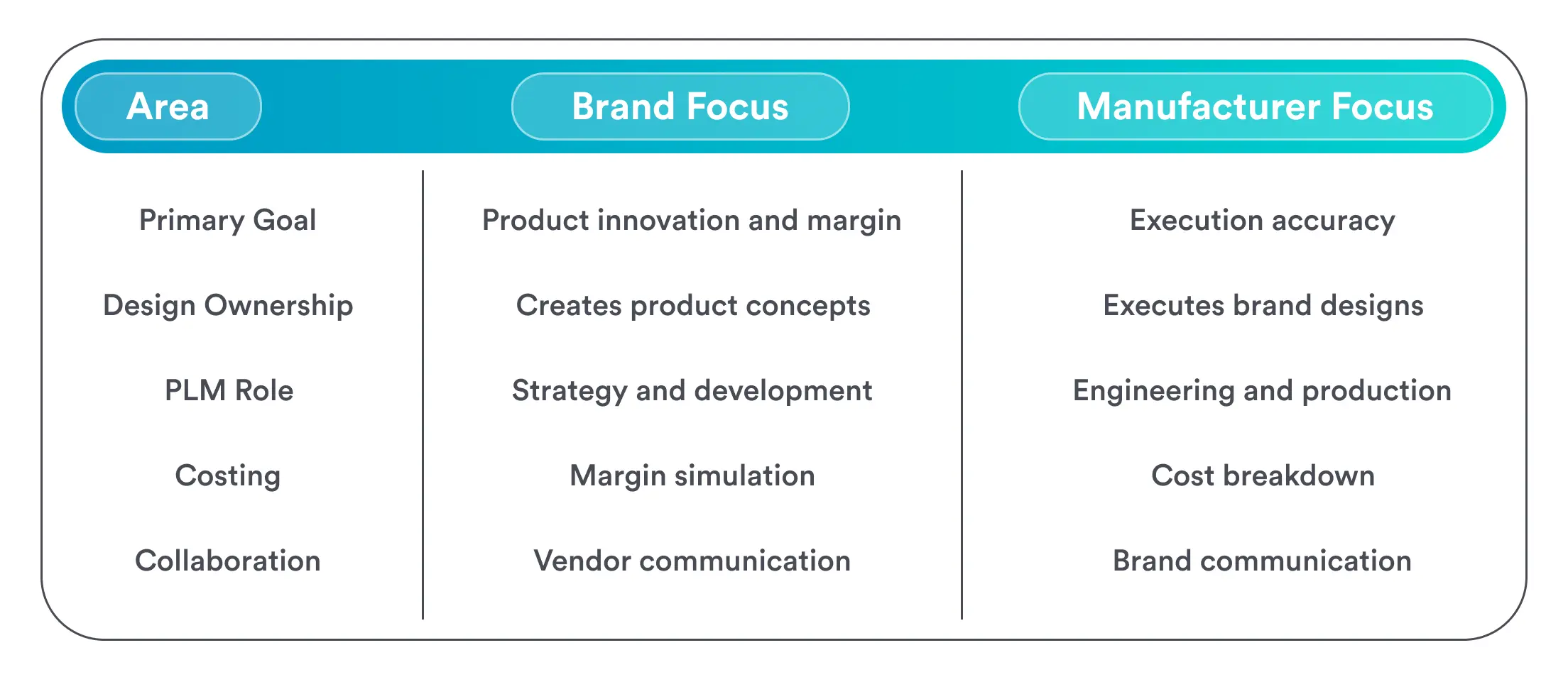
    Key Difference Between PLM Use of Brand and Manufacturer

    PLM Use of Brand and ManufacturerIn simple terms, brands use PLM to drive product strategy, innovation, and profitability, while manufacturers rely on it to turn those ideas into accurate, production-ready outcomes. This difference shows how PLM supports both creative planning and execution across the fashion value chain.


    How AI is Transforming Fashion PLM

    AI is Transforming Fashion PLM

    Traditional PLM systems classify product data. However, they depend on users to take the time to parse that data themselves.

    Artificial intelligence is altering this relationship by automatically reading, interpreting, and acting on product information in PLM systems.

    This evolution is transforming PLM into a decision intelligence platform.

    1. AI-Powered Visual Product Discovery

    Visual recognition is one of the strongest capabilities of AI-driven PLM platforms.

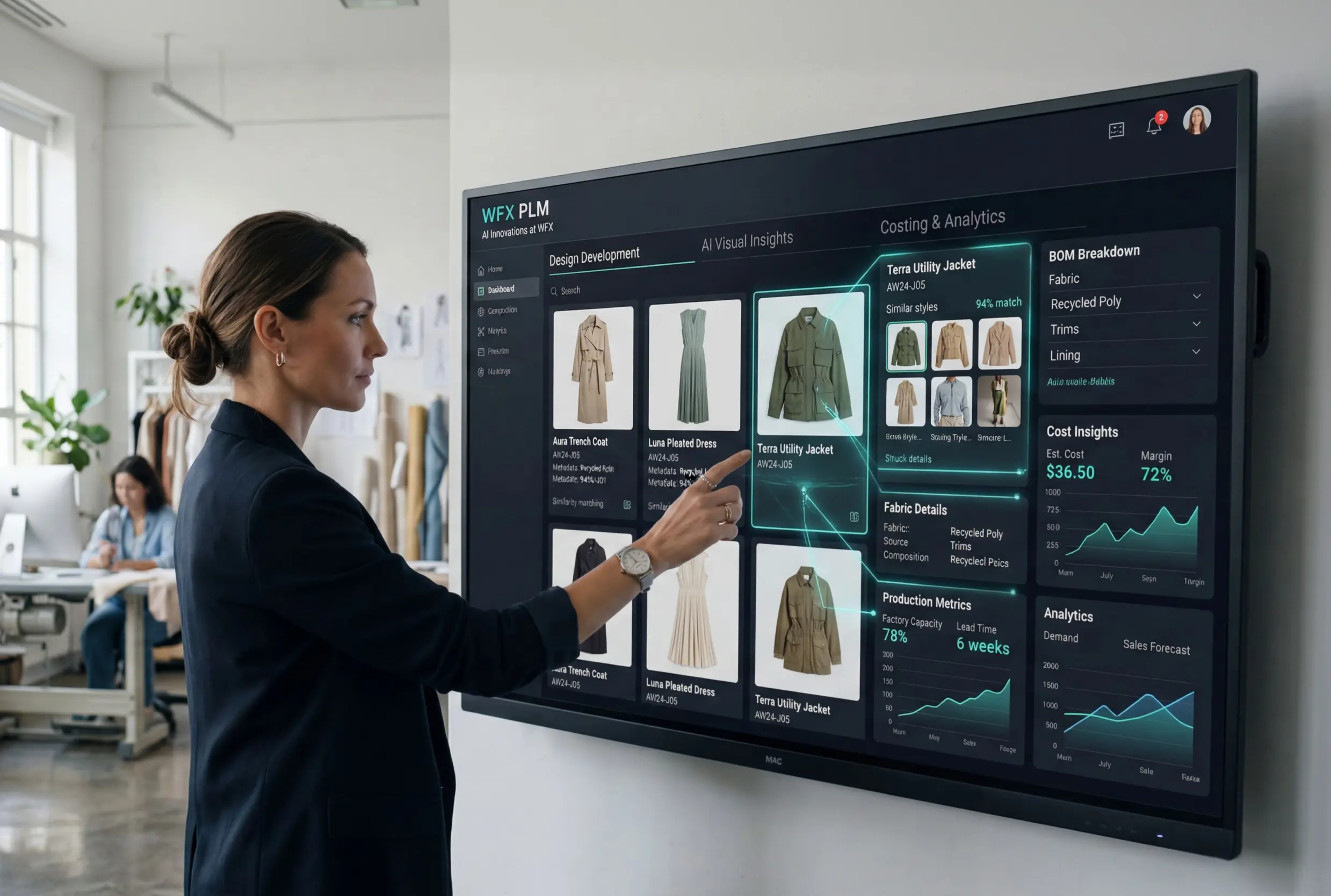
    For example, WFX AI lets users upload a reference image and immediately find similar styles from their own product archive.

    The system examines visual characteristics like:

    • design details
    • fabrics
    • trims
    • product structure

    It then pulls up related styles from historical collections.

    When a similar product is recognized, AI can automatically gather relevant information like:

    • BOM details
    • fabric specifications
    • trims and materials
    • costing information
    • technical measurements

    This enables teams to reuse already validated product data while preventing unnecessary duplicate sampling.

    2. AI Tech Pack Reading

    Unfortunately, many brands continue to send tech packs in PDF format, making it nearly impossible to extract product information from this unstructured data.

    Here comes the AI-powered tech pack reader that solves this very problem.

    For example, with WFX AI Techpack Reader, users can upload a buyer tech pack PDF and have the AI automatically extract and structure the information.

    The system can:

    • Pull fabrics, trims, and BOM info
    • Capture measurements and product specifications
    • Organize information into ERP-ready fields
    • Flag missing or inconsistent data

    This significantly reduces manual data entry and prevents errors before they reach production.

    For manufacturers processing hundreds of tech packs across several brands, this function can greatly enhance operational efficiency.

    3. AI Order Intelligence

    Sales orders come in all different formats, like email attachments or documents. Inputting order information into ERP systems can be labour-intensive and mistake-prone.

    This is where AI-powered order intelligence comes into play to automate the process.

    Uploading an order document, AI can:

    • Capture key order details
    • Validate pricing against product data
    • Verify delivery timelines
    • Cross-check inventory and production capacity

    If the system detects quantity mismatches, pricing changes, or delivery risks, it alerts teams immediately.

    This ensures that orders are confirmed only on the basis of real, available data and realistic production capacities.

    4. AI Production Planning

    Production planning is one of the most complicated problems in apparel manufacturing.

    Factories need to juggle several variables, including:

    • order priority
    • delivery deadlines
    • line efficiency
    • style changeovers
    • capacity utilization

    Machine learning-powered planning tools, such as the WFX AI Planner, help production teams create optimal scheduling scenarios with a single click.

    Users simply type a planning goal (e.g., a targeted buyer or a delivery date).

    The AI planner takes in operational data and outputs multiple production planning alternatives for teams to select which is the most efficient plan.

    This allows decisions to be made more promptly, enhancing factory productivity.

    From System of Record to System of Intelligence: The Future of Fashion PLM

    Conventional PLM platforms are systems of record. They hold product details and facilitate team collaboration.

    AI-driven PLM platforms deliver a lot more.

    They examine historical data, identify patterns, and produce smart insights that enable organizations to make better decisions.

    Within PLM, AI smart back-end systems can produce results like:

    • “This particular style closely resembles a successful product from a season or two past.”
    • “Increased cost risk due to fabric price escalation.”
    • “Delivery timeline may be affected by production capacity constraints.”

    AI is at the heart of product lifecycle management (PLM) for fashion.

    Bottom Line

    Fashion brands are under relentless pressure to create products in shorter timeframes, cut costs, and manage complex global supply chains.

    Most Fashion PLM systems already offer this functionality in how brands manage product data and collaborate with manufacturers.

    As a result, PLM’s next generation is much more powerful, thanks to the addition of AI capabilities such as visual product discovery, automated tech pack processing, order intelligence, and AI-based production planning.

    Solutions like WFX AI Powered have shown that fashion companies need to convert their product data into actionable insights, further optimizing operations and speeding up product development.

    As the fashion industry evolves, with new challenges for more sustainable products, AI-enabled PLM platforms will be key capabilities to help brands and manufacturers compete in a highly data-driven future.

    Frequently Asked Questions

    How do Fashion PLMs use AI?

    In the field of Fashion PLM, AI is used to automatically manage product data, analyze past design styles, extract information from tech packs, and assist designers in decision-making throughout product development and production planning.

    AI can help fashion companies minimize manual work, improve cost accuracy, and identify production risks earlier in the lifecycle.

    What are the benefits of AI-powered Fashion PLM?

    Key benefits include:

    • Faster product development cycles
    • Reduced sampling costs
    • Automated tech pack processing
    • Improved costing and margin visibility
    • Smarter production planning

    Can AI read fashion tech packs?

    Yes. Tech pack PDFs can be fed into modern AI systems that scan and learn the measurements of BOMs, fabrics, and other components.

    For instance, WFX AI Techpack Reader technology transforms raw marketing documents into machine-readable physical information, ready to be copied directly from the physical tech pack into the ERP system without manual data entry or copy-paste errors.

    How is AI revolutionising fashion production planning?

    It can also generate an optimized production planning scenario based on a combination of the entered information, including analyses of production capacity, delivery timelines, order priorities, and line efficiency.

    For example, AI production planners enable manufacturers to simulate different scheduling alternatives and pick the most efficient plan.

    Run your fashion business on one unified platform.

    WFX connects product, sourcing, production, and finance – so decisions happen faster, with clarity.

    Unified PLM, ERP, and factory operations
    Real-time visibility across the value chain
    Built for fashion. Trusted globally

    Read Our Blogs

    ...
    A Complete Guide to Selecting the Right Cloud ERP for Footwear Manufacturing in 2026

    Choose the best cloud ERP for footwear manufacturing to boost efficiency and growth

    Read More
    ...
    Top 7 Fashion PLM Software Solutions for Apparel Brands in 2026

    Discover top Fashion PLM software solutions helping apparel brands streamline product development in 2026.

    Read More
    ...
    How Garment ERP software helps manufacturers save time, money and effort

    Garment ERP software streamlines operations, saving manufacturers time, money, and effort for improved efficiency and productivity.

    Read More